Tencent released the model weights for Hy4 preview, its new leading Mixture-of-Experts AI model designed for coding, office work, scientific research, and other productivity tasks. The company allows anyone to download, modify, fine-tune, and use it for commercial purposes under the Apache 2.0 license.
Hy4 is currently the most advanced model in the Hunyuan family. It comprises 770 billion total parameters, activates 49 billion parameters per token, and supports a context window of one million tokens, advancing with more than twice the capacity of Tencent’s previous-generation Hy3.
This image shows a benchmark grid comparing Hy4 preview against seven other major AI models across various evaluation datasets:
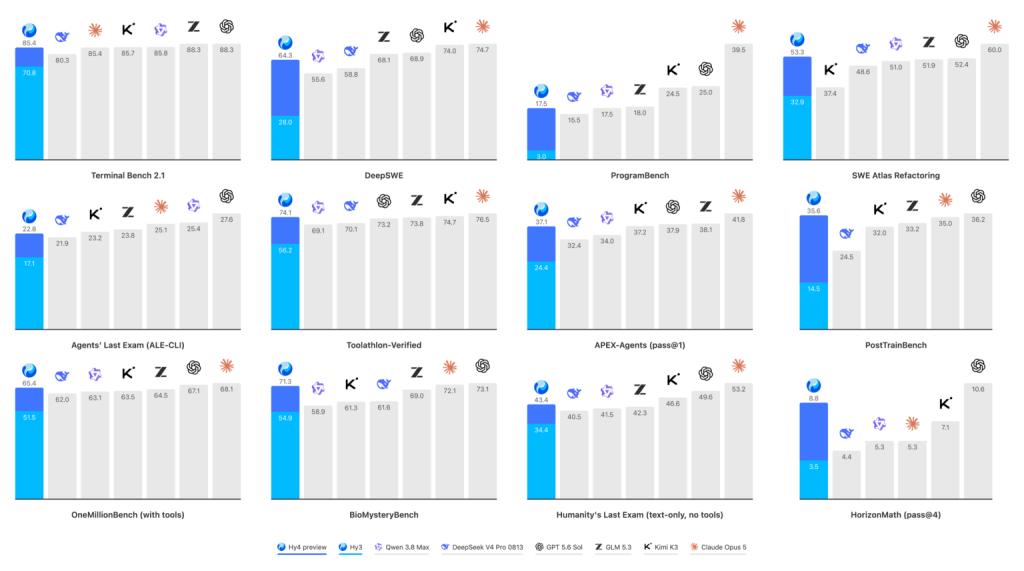
In every category, Hy4 preview (bright blue) shows a substantial improvement over its predecessor Hy3 (represented by the darker base portion of the stacked bar). Hy4 preview also outperforms top frontier models, including GLM 5.3, Kimi K3, GPT 5.6 Sol, Claude Opus 5, and DeepSeek V4 Pro across 10 out of the 12 evaluation benchmarks shown.
How can you access Hy4 preview?
Hy4 preview is available through Tencent Cloud TokenHub, OpenRouter, and Tencent products such as WorkBuddy, CodeBuddy, Yuanbao, and ima. Developers can also download the model weights from GitHub or Hugging Face and self-host them using deployment frameworks such as vLLM or SGLang. Two model variants are available: the standard BF16 version and an FP8-quantized version.
What hardware does it need?
Hy4 preview is a very large model and self-hosting requires high-end GPU hardware. Tencent’s official deployment examples use 8 GPUs with the FP8 version using vLLM or SGLang. The standard BF16 version requires significantly more GPU memory because the model weights are larger. For fine-tuning, the requirements are even higher: Tencent reports a minimum of 64 GPUs with at least 96 GB of GPU memory each for LoRA fine-tuning, while full fine-tuning requires 128 GPUs with at least 96 GB each.
Therefore, Hy4 preview is not designed to run on a typical PC; you will need to access the model through a cloud service.
Cost of running Hy4 via API
Hy4 preview is cost-effective via API, especially considering the size of the model. On OpenRouter, it costs $0.834 per million input tokens and $2.501 per million output tokens, and $0.042 per cached input. Tencent Cloud TokenHub lists the model at ¥6 ($0.90) per million input tokens and ¥18 ($2.69) per million output tokens. Prices vary by provider and may change over time.
Evaluation
Tencent has been competing with major Chinese model developers such as DeepSeek, Alibaba’s Qwen, Zhipu AI’s GLM, and Moonshot AI’s Kimi in the open-weight AI market. In an internal blind, side-by-side evaluation, 163 experts assessed model outputs across 203 engineering tasks. Hy4 preview achieved an average score of 2.99 out of 4.00, compared with 2.92 for GLM 5.3 and 2.94 for Kimi K3. In pairwise comparisons, Hy4 preview outperformed GLM 5.3 in 46.8% of cases, and better than Kimi K3 in 51.2% of cases. As this evaluation was conducted by Tencent, readers should not treat it as an independent benchmark.
Tencent also mentions some practical limitations of its new frontier model. Hy4 preview may spend excessive time reasoning through complex problems and has a tendency to repeatedly verify or revisit its own work. This cautious behavior can increase latency and token usage, making the model less efficient for tasks where speed matters.
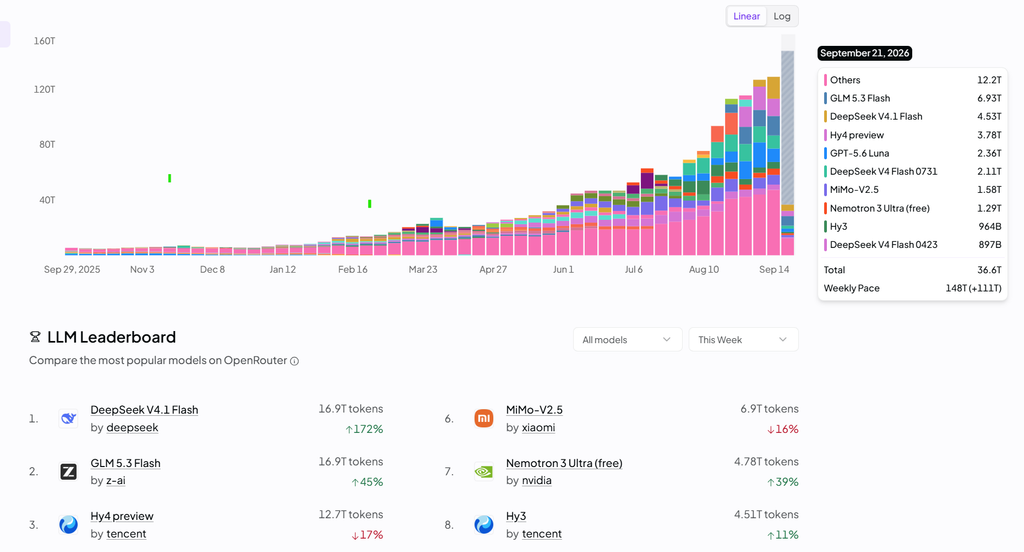
Hy4 preview ranked third among the most popular models on OpenRouter’s September 21 leaderboard, as measured by tokens processed.
Why the open-source releases matter
The release of powerful models as open-weight systems is a strategy that could have profound financial consequences for the global AI industry. In August and September 2026 the large number of Chinese model releases are accelerating the shift from AI as a product toward AI as infrastructure.
Recent major releases from Chinese AI labs include Moonshot AI’s Kimi K2.8 preview (July 27, 2026); Alibaba’s Qwen3.8-Max (August 3); DeepSeek’s DeepSeek-V4-Pro (August 13); Zhipu AI’s GLM-5.3 and GLM-5.3-Flash (August 14); Tencent’s Hy4 preview (August 28); and DeepSeek’s DeepSeek-V4-Flash-Vision-Exp (August 31). The wave continued in September with DeepSeek’s DeepSeek-V4.1-Flash (September 10) and Alibaba’s Qwen3.8-Omni-Flash (September 18), marking a broader shift toward large-scale open models, multimodal systems, agentic AI, and more efficient inference.
China’s open-source releases are not merely another iteration in the model race. They represent a pricing strategy in the economics of AI itself. Open-weight releases can compress model prices and margins, but they can simultaneously expand the market for cloud infrastructure, inference hosting, custom chips, and enterprise software services. If models become sufficiently capable and increasingly interchangeable, customers may become less willing to pay large premiums for proprietary access. Building smarter AI models does not always mean monetizing them effectively. The next stage of AI investment will be about who can use cheaper AI to build strong, profitable businesses.