Muse is Meta’s new personal AI agent designed to perform routine digital tasks, such as sending emails, booking travel, paying bills, or interacting with third‑party services. The engine behind Muse is Muse Spark 1.3, Meta’s latest AI model for advanced agentic and coding workloads.
On September 8, 2026, Meta introduced Muse, a personal AI assistant built for everyone that can do more than just hold conversations. Rather than simply providing instructions, it carries out tasks on your behalf, pausing only when an action requires your explicit approval. The main idea behind Muse is to reduce the amount of your routine digital work.
The agent, internally known as “Hatch” during development, is powered by Meta’s Muse Spark family of foundation models. It includes the latest Muse Spark 1.3 which was introduced on September 2, described as its most capable model to date for agentic and coding tasks. Muse Spark 1.3 can handle long-context reasoning, use external tools, and manage complex coding and agent workflows.
Along with real-time audio models such as Muse Voice Transcribe, these updates make it clear that Meta is building a broader AI agent platform. For technical teams, the shift is significant: AI is moving from text‑only chat toward systems that invoke tools, manage multi‑step workflows, and execute actions for users.
Muse capabilities
Muse is built to handle essential everyday digital tasks, including:
- Communication and scheduling: Managing emails, calendars, and event invitations.
- Travel and planning: Booking trips, managing reservations, and creating itineraries.
- Commerce and finance: Shopping, completing checkout, and negotiating bills or subscriptions.
- Data and admin: Filling out online forms and converting media (like recipe reels) into actionable lists.
The agent connects to your everyday apps via standard APIs and can open a dedicated browser to create tools when no direct API exists. You can give Muse a goal or task and it creates an action plan, tracks your progress, and proactively takes care of tasks along the way. As it learns and becomes more capable, it suggests tailored ideas, ready for immediate action.
The agent connects to your everyday apps via standard APIs and can open a dedicated browser to interact with services when no direct API exists. You can give Muse a goal or task, and it creates an action plan, tracks your progress, and proactively takes care of tasks along the way. Muse can be accessed on smartphones, laptops, and desktop computers, allowing users to interact with the agent across different platforms. As the agent learns and becomes more capable, it suggests tailored ideas, ready for immediate action.
To handle financial transactions autonomously, Muse uses Link by Stripe for online checkout. Every time Muse completes a purchase, the system generates a single-use card number through Link. This ensures your real credit or debit card credentials are never exposed to merchants or directly visible to the AI agent. Meta says support for Shopify’s Shop Pay and 1Password is also coming soon.
Through app connectors, the agent runs in the background to track long-term goals, monitor important updates, set reminders, and execute tasks without requiring manual oversight. Even after you close the app, Muse keeps working. For example, if you ask Muse to monitor the daily weather and notify you when rain is expected, it can do so automatically without you having to check back in.
Nevertheless, you remain in control. Muse requires explicit user confirmation before executing sensitive or high-risk actions, such as sending emails or completing purchases. The agent never sees or displays your passwords or payment details. Your credentials stay hidden and encrypted. Muse can complete approved tasks using your stored accounts, while the AI never sees, reads, or stores your passwords or financial details.
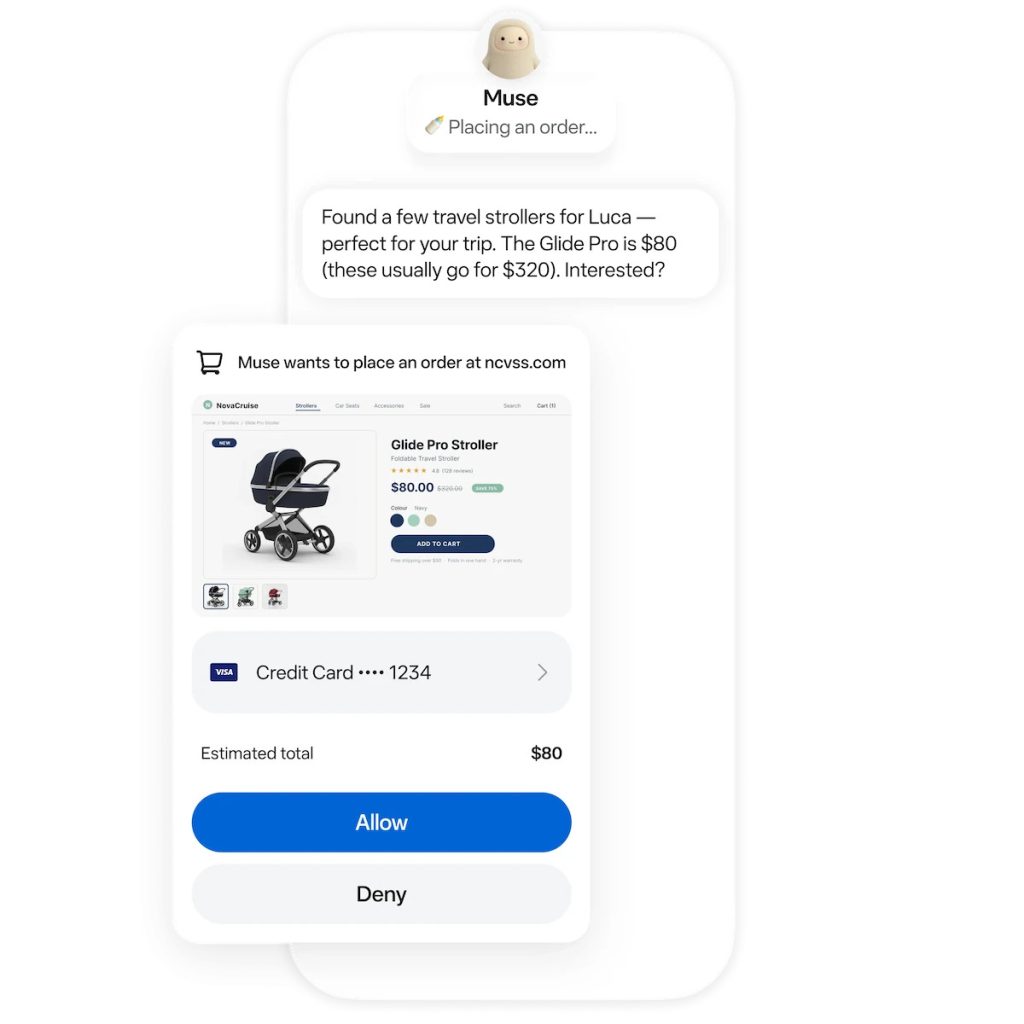
You can also view a live activity log that displays every action Muse has taken and all steps it plans to execute next.
Supported platforms
Based on Meta’s September 8, 2026 announcement, Muse is available in the United States on the web at muse.ai, iOS and Android apps, as well as on the WhatsApp chats. Meta says the agent will soon be available on its AI glasses as well.
The WhatsApp integration is particularly notable. WhatsApp has more than 2 billion users worldwide, and Meta’s decision to embed Muse directly into chat threads gives it a distribution advantage that few competitors can match.
Pricing
Meta’s Muse is offered through different pricing options. For consumers, there are three main plans based on weekly usage limits:
- Free Tier: Available at no cost, with a weekly limit of 1 million input tokens and access to all features.
- Power Plan: Costs $20 per month and increases the weekly limit to 500 million input tokens.
- Maximum Plan: Costs $100 per month and is intended for users with higher usage needs.
Meta also offers separate API pricing and rate limits for developers:
- Standard Tier: Offers higher usage limits, including up to 3,000 requests per minute (RPM) and 4 million tokens per minute (TPM). Muse Spark 1.3 costs $1.25 per million input tokens and $4.25 per million output tokens.
- Contributor Tier: Offers lower-cost access at $0.10 per million input tokens and $0.20 per million output tokens. In this tier, Meta may use prompts and outputs to improve its products. The tier has lower usage limits, with up to 100 requests per minute (RPM).
Muse Spark 1.3 Contributor is currently available for free through OpenCode Zen for a limited time. During this period, the team is collecting user feedback to help improve the model.
Muse Spark 1.3 – the engine behind Muse
Meta powers Muse with Muse Spark 1.3, an agentic foundation model that can process text, images, and video and generate text responses. With a 1,048,576-token context window, Muse Spark 1.3 can handle long-running agent tasks, analyze large codebases, and work with large documents.
Users can access Muse Spark 1.3 through Meta Model API or use it directly in Muse Code, Meta’s coding agent for software development.
Evaluating Muse Spark 1.3
Early results from Meta’s internal testing suggest that Muse Spark 1.3 is more efficient than Spark 1.2, using about 20% fewer tool calls and 25% fewer tokens. However, the comparison isn’t strictly equivalent because 1.3 was tested at max reasoning while 1.2 was evaluated at xhigh reasoning. This suggests that the reported efficiency gains stem from two factors: improvements to the model itself and differences in the reasoning settings.
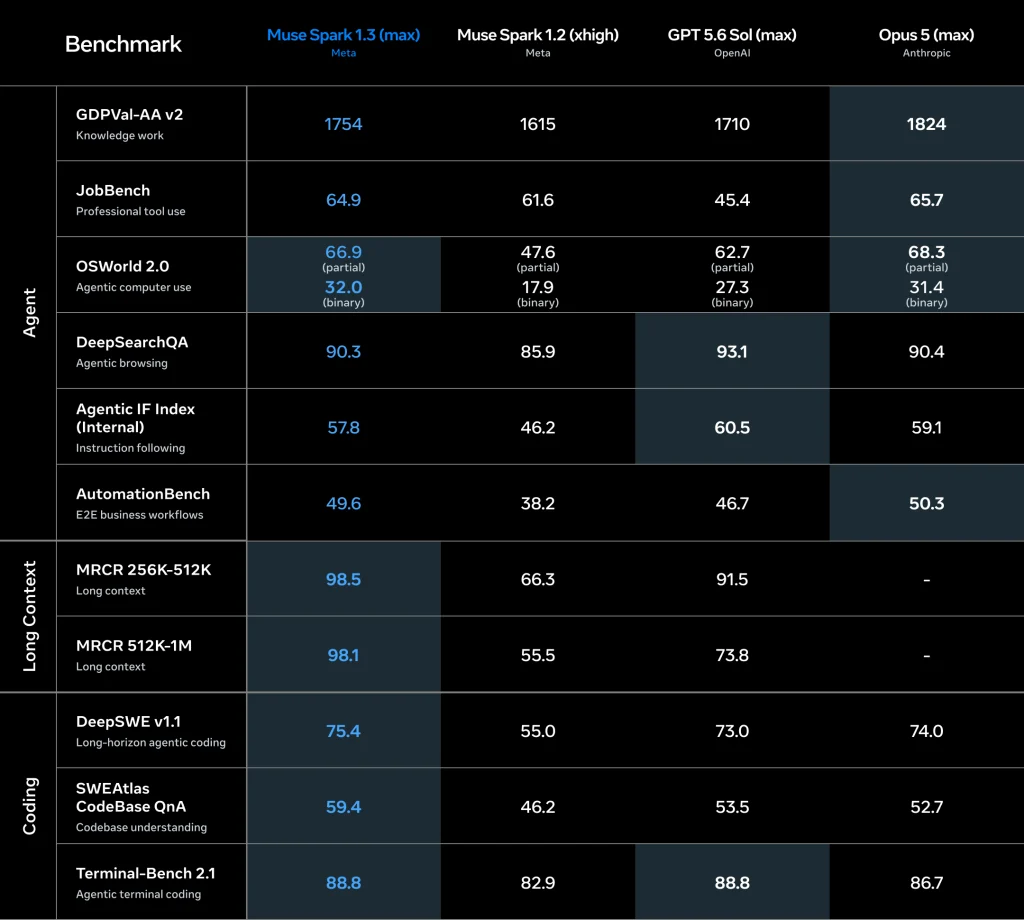
As compared to other models, Spark 1.3 shows a clear advantage in coding and strong long‑context retrieval, but it does not lead across all agentic tasks. On broader agent benchmarks, Claude Opus 5 still performs better in several areas.
Muse Spark 1.3 was also evaluated by Artificial Analysis alongside other coding-agent and model configurations. The following bar charts compare their performance across three key metrics:
- Intelligence: Measures overall task success and code quality on a 0 – 100 scale (higher is better).
- Speed: Measures the time required to complete a coding task, in minutes or hours (lower is better).
- Cost per Task: Measures the average API cost of completing a coding task (lower is better).
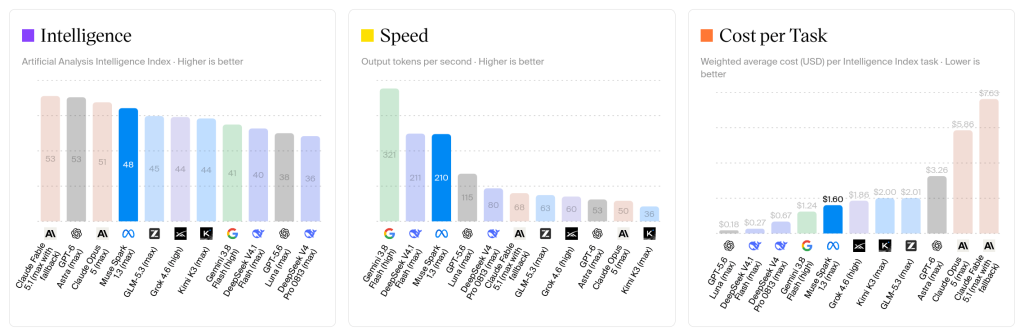
Muse Spark 1.3 demonstrates an optimal balance of performance, velocity, and cost efficiency.
The next chart compares 26 selected models out of 650 on two dimensions: average cost per Artificial Analysis Intelligence Index task (USD) and Artificial Analysis Intelligence Index, a composite intelligence/quality score. Muse Spark 1.3 (max) sits in the most favorable quadrant, in close proximity to GPT-6 Astra.
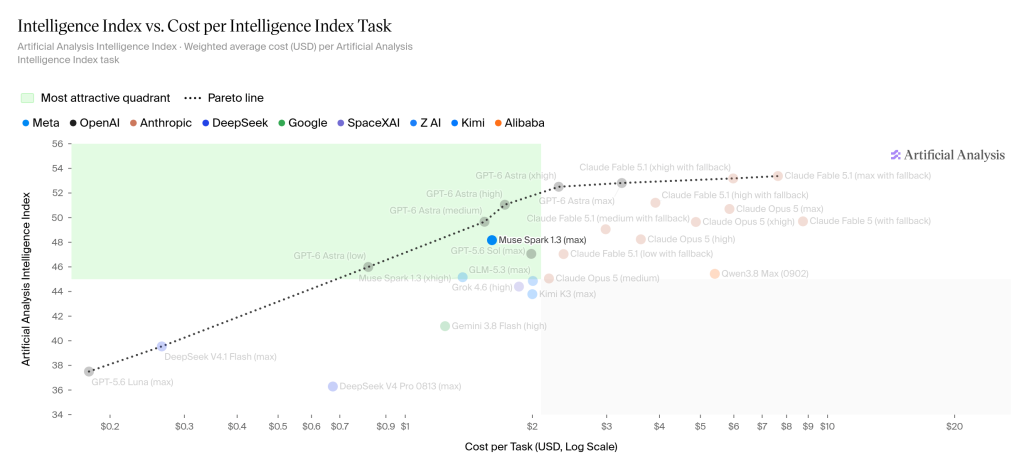
Muse Spark 1.3 (max) is suitable for workloads that require stronger reasoning, higher overall intelligence, and more capable performance across complex tasks. For simpler tasks such as classification, information extraction, summarization, routing, and lightweight content generation, other models may provide sufficient performance at a more affordable price. Models such as Muse Glimmer, gpt-oss-120b, Gemini 3.5 Flash-Lite, GPT-5.6 Luna, and GLM-5.3-Flash offer much lower costs.
What we think
Muse Spark 1.3 is not necessarily the best choice for every workload. Lower-cost models can be more efficient for simple, high-volume tasks, while frontier models such as Claude Opus 5 may still offer stronger results on some knowledge-work and agentic benchmarks.
We see Muse Spark 1.3 as a strong general-purpose model for complex software development and agentic workloads. However, it is better viewed as another capable option in the model landscape than as a replacement for every model on the market.
Conclusion
Meta’s September 2026 launches of Muse and Muse Spark 1.3 highlight the company’s growing focus on agentic AI. The two releases target systems that can use tools, maintain context, handle complex multi-step tasks, and operate reliably across longer workflows. Muse brings these capabilities to a personal AI agent, while Muse Spark 1.3 focuses on the underlying model capabilities needed for coding and other agentic workloads.
For developers, the most interesting part of the Muse launch may be Spark 1.3 which makes a practical balance between coding quality, reasoning capability, speed, and cost. Meta’s benchmark data shows that the new model performs especially well in long-context tasks, repository comprehension, software engineering, and multi-step agentic coding.
Looking ahead, the company must expand Muse beyond the U.S., add more service integrations and demonstrate that consumers are comfortable giving an AI agent continuous access to their personal data.
Read more:
- “Introducing Muse. Your personal AI agent that gets things done” (Meta)
- “Introducing Muse Spark 1.3” (Meta)
- “Independent analysis of AI” (Artificial Analysis)