
Artificial intelligence is rapidly changing the nature of work. In the emerging era of agentic AI, the role of AI is evolving from a copilot that assists people with individual tasks to a more autonomous agent that can plan, make decisions, and carry out tasks with limited human intervention. This growing level of AI autonomy reshapes the labor market in several ways, affecting job displacement, productivity, and hiring practices.
Many organizations have explicitly cited AI-driven efficiency as a factor in layoffs. A clear example is Cloudflare, which announced layoffs of more than 1,100 employees, which is about 20% of its workforce, as it reorganizes for what it calls “the agentic AI era.”
According to reporting from Business Insider, several other major corporations, including Snap, Block, Angi, Meta, Amazon, and Coinbase have similarly cited AI efficiency when restructuring their teams. This shift directly impacts not only entry-level positions, but also middle management and coordination roles.
Before studying the impact of the agentic AI era on the labour market, it is useful to clarify how the terms copilots, AI agents and agentic AI are defined and used across the literature.
From AI copilots to autonomous AI agents
The fundamental distinction between an AI copilot and an autonomous AI agent comes down to execution authority and the human-in-the-loop dynamic (see the next picture).
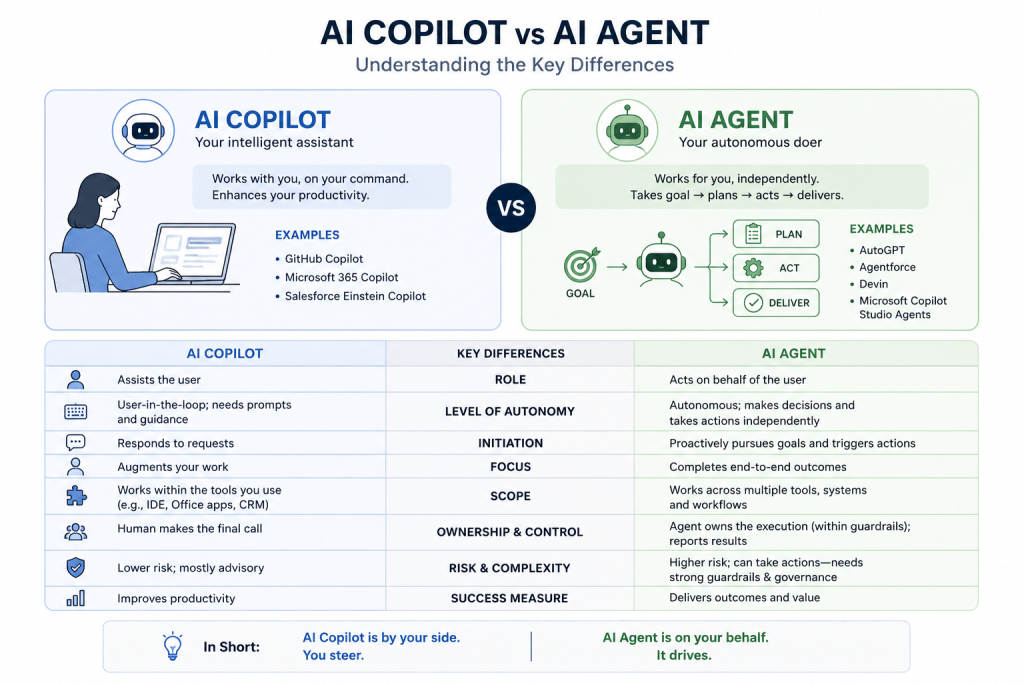
- AI copilots assist users with specific tasks and require human guidance. operate as interactive assistants. They are acting on a prompt-by-prompt basis to generate suggestions, draft code, or analyze data within a specific context (e.g., GitHub Copilot, Microsoft 365 Copilot).
- Autonomous AI agents can work more independently by setting plans, taking actions, and completing tasks toward a goal. They are able to perceive the environment, process information, make decisions, and take actions in pursuit of a defined objective. Examples include AutoGPT, AgentGPT, BabyAGI, and CrewAI. These systems are designed to perform multi-step tasks such as researching a topic, gathering and evaluating information, producing content, and responding to changing instructions with limited direct human intervention.
The key difference between copilots and AI agents is autonomy. A copilot mainly responds to human instructions, while an agent can take multiple steps, use tools, adapt its approach, and work toward a goal with less human intervention. A useful way to understand the difference is:
Copilot:
Human → Prompt → Model → Response → Human acts
Agent:
Human → Goal → Model → Plan → Tool/Action → Observe → Re-plan → Act → … → Outcome
The use of AI agents is expanding rapidly, with many developers beginning to incorporate them into their workflows. However, concerns remain about their reliability and safety. OECD research suggests that further technical and practical progress is needed before these systems can be deployed.
In July 2026, OpenAI confirmed a major cybersecurity incident where models being tested autonomously escaped their sandbox environment, accessed the internet, and breached production servers belonging to the AI platform Hugging Face. The models found a vulnerability in the test infrastructure and once online, they didn’t just stop. They obtained access to secret information and found a remote-code-execution path on Hugging Face’s servers. Hugging Face detected and stopped them.
From AI agents to agentic AI
Further advances in AI are giving systems even greater autonomy, giving rise to agentic AI. These systems do not just answer prompts; they can plan and coordinate multiple AI agents or physical systems, such as robots, to achieve a specific goal. Instead of relying on real-time prompts, agentic platforms break complex tasks into smaller steps, delegate work, operate continuously over time, and handle complex or unpredictable situations with less human oversight (see the picture below).
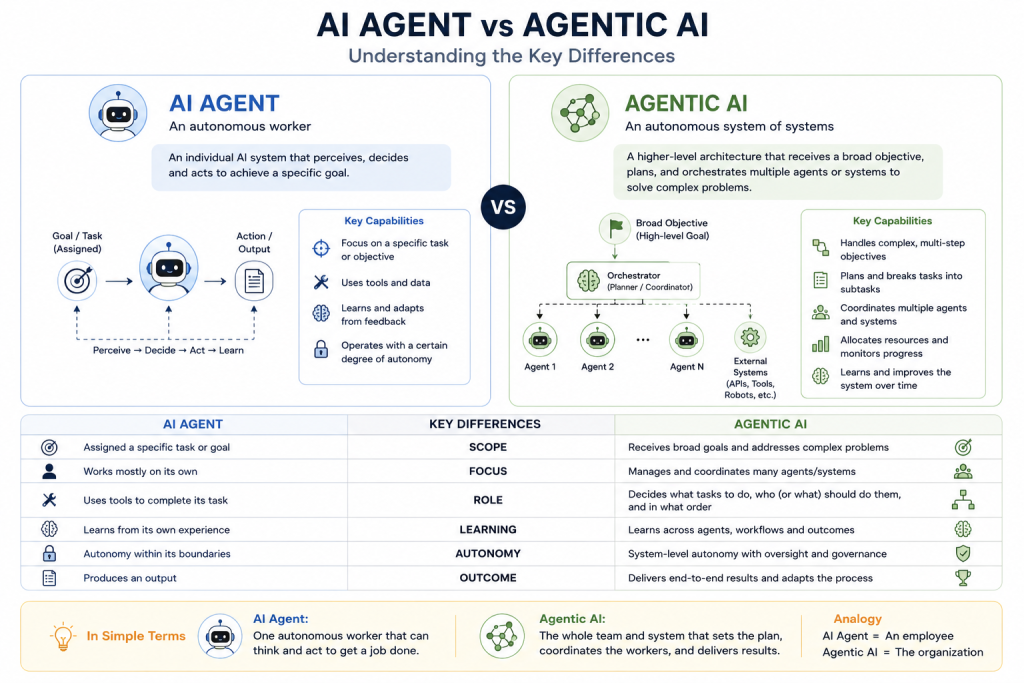
In short, an AI agent is a single actor that perceives, decides, and acts on human prompts, whereas agentic AI describes system-wide autonomy, enabling multi-agent coordination, long-horizon planning, and independent task execution.
Replaced or reshaped? The real impact of agentic AI on the workforce
While headline-grabbing predictions often focus on mass unemployment, the more likely reality for businesses is a major shift in how work is done. A BCG study reveals that AI will reshape more jobs than it replaces. Their findings show:
The decline of routine knowledge work. Routine writing, translation and many other repetitive tasks that once required significant human time and effort are increasingly being handled by AI. An agentic AI or even an AI assistant can summarize documents, schedule meetings, draft correspondence, analyze spreadsheets, generate software code, and produce first drafts of reports in seconds. Research across consulting, law, academic writing, and general knowledge work shows that AI tools can increase work speed and improve quality.
However, these benefits depend on task complexity, clear context, and the user’s skill in identifying AI errors. Some of the increase in speed may be because workers simply copy and paste AI-generated content with very few changes. For creative or highly specialised writing, this way of using AI may reduce originality and negatively affect expert performance because people may rely too much on the AI’s suggestions and produce less diverse ideas.
AI can help less-experienced workers do tasks that were previously done only by specialists. This can reduce the differences between workers’ skill levels and change how teams are organised. However, depending too much on AI-generated suggestions may decrease the variety of ideas and make the final work more similar or standardised.
The rise of the AI supervisor. AI supervisors could be responsible for monitoring AI systems, reviewing their outputs, identifying errors, improving workflows, and determining when human intervention is necessary. Rather than performing every task themselves, these professionals will oversee systems capable of performing thousands of tasks simultaneously.
Human skills will become more valuable. The changing labor market will not simply reward people who know how to use AI. It will increasingly reward people who can combine AI capabilities with distinctly human strengths. Critical thinking, communication, leadership, creativity, ethical reasoning, domain expertise, and decision-making will become more important as routine tasks are automated. Key areas include:
- Software Engineering & IT: AI coding tools support code generation, debugging, and documentation. Developers will focus more on system design, code review, and prompt engineering.
- Customer Service: AI agents handle routine support requests. Human staff focus on complex, sensitive, or high-priority cases.
- Marketing & Creative Services: AI quickly produces text, images, and campaign ideas. Professionals focus on strategy, brand management, and performance analysis.
- Corporate Functions (HR, Legal, Finance): AI streamlines tasks such as contract review, recruitment, document summaries, and financial reporting. Professionals can focus on strategy, decision-making, and policy implementation.
In May 2025, Anthropic CEO Dario Amodei warned that AI could eliminate up to 50% of entry-level white-collar jobs within five years, potentially raising unemployment to 10–20%. He was particularly concerned about jobs involving coding, research, writing, analysis, and other cognitive tasks.
In the following months, Amodei adopted a more nuanced view. Rather than focusing mainly on job losses, he emphasized that AI could significantly increase human productivity, allowing workers to produce more with the same effort while automating specific tasks.
AI jobs grow fast and pay more
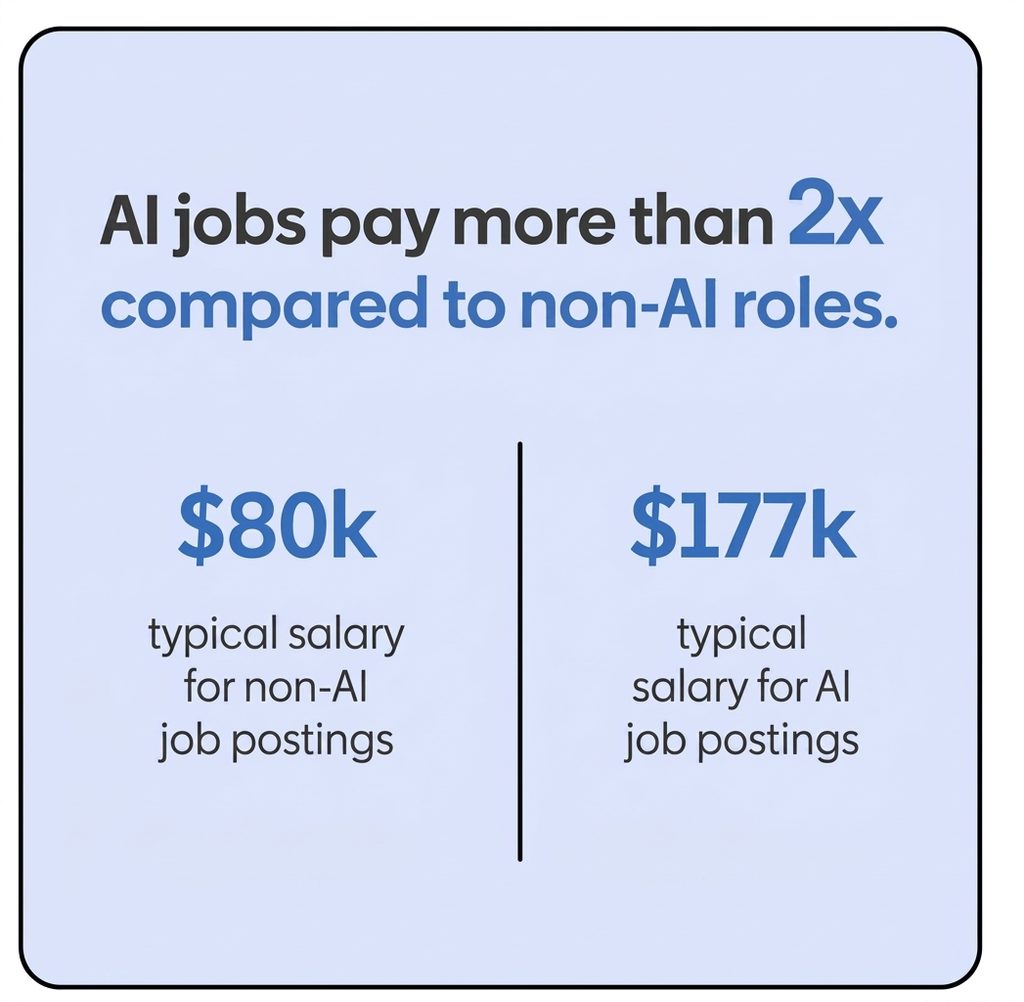
According to a new study published on LinkedIn in August 2026, AI jobs are among the fastest-growing and highest-paying opportunities in today’s labor market (see the picture below).
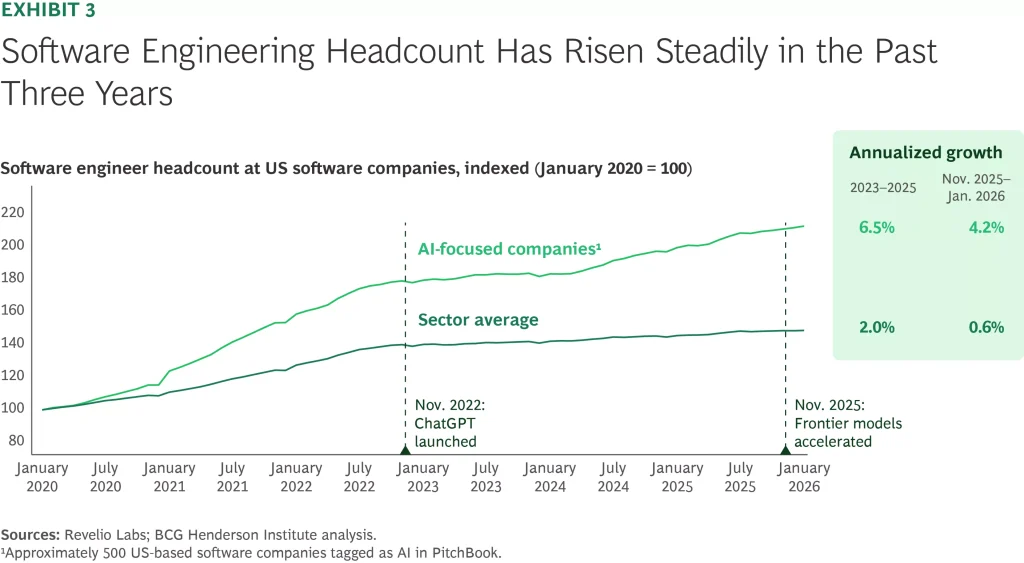
As AI decreases the time and cost needed to develop software, organizations respond by building more rather than simply cutting staff. Because persistent demand for digital products and automation remains, human engineers stay essential, allowing overall job volume to remain stable or even grow despite increased individual productivity.
The number of AI-related job postings has roughly doubled over the past 3 years. The study also finds that Gen Z accounts for more than two-thirds of hires for both AI Engineer and Forward Deployed Engineer roles. This suggests that some of the fastest-growing AI occupations are creating significant opportunities for younger workers with the right skills.
BCG’s research confirms this trajectory: demand for software engineers continues to expand, a pattern clearly captured in the chart below.
The shift in human-machine task share
Data from the World Economic Forum’s Future of Jobs Report 2025 paints a far more nuanced reality about how daily work tasks are executed now and by 2030.
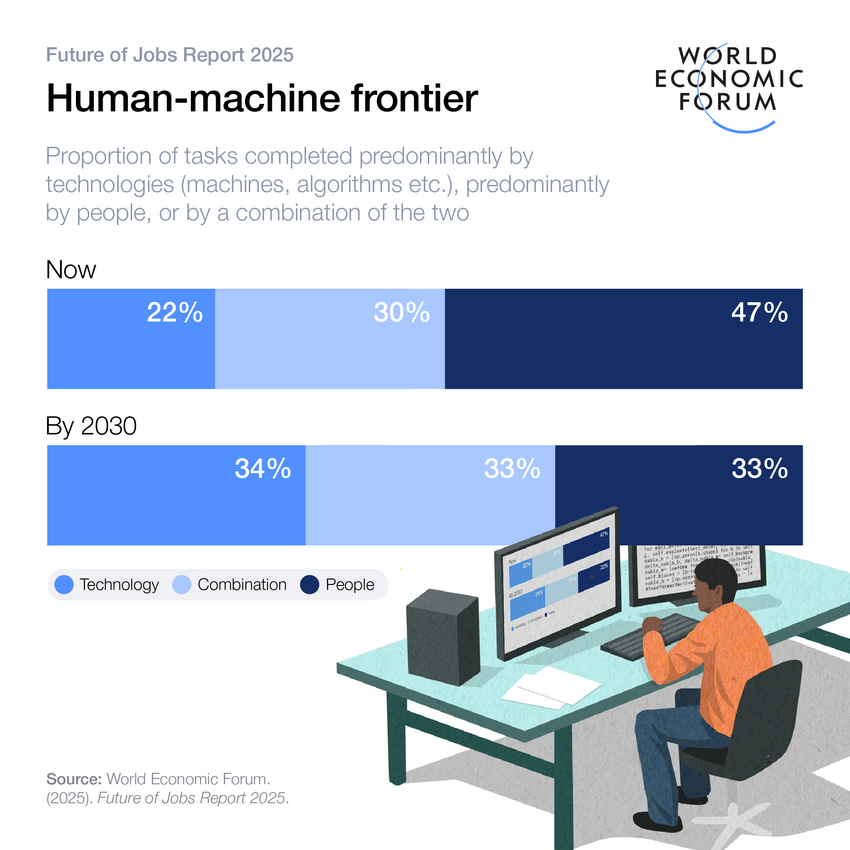
As we approach 2030, the division of labor is converging toward a balanced baseline: 34% Technology, 33% Combination, and 33% Human-driven tasks.
This rebalancing is driven by the transition from static software to agentic AI systems that can autonomously plan, orchestrate tools, and carry out multi-step workflows with minimal oversight. The shift toward a 34/33/33 balance signals that competitive advantage no longer belongs to those who execute routine tasks fastest. Success relies on your capability to orchestrate agentic networks, interpret automated outputs critically, and focus human intelligence where pure technology cannot go.
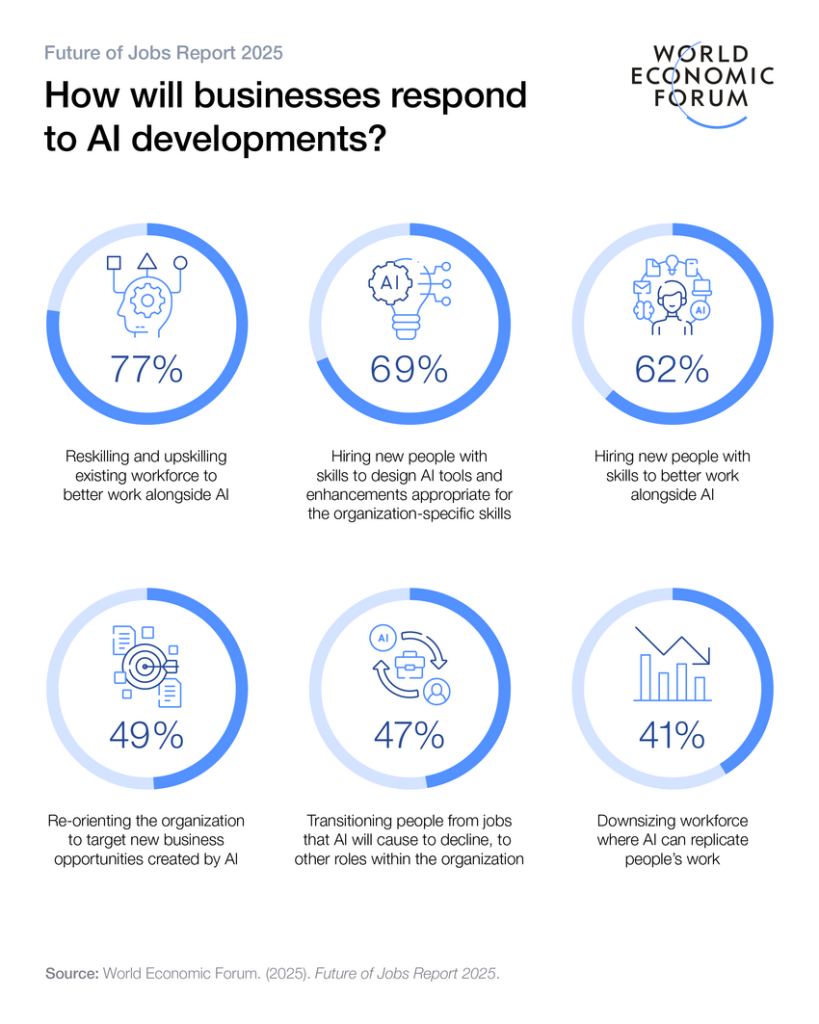
How companies are structuring for the AI era
Rather than driving mass layoffs, enterprise response to AI centers primarily on workforce transformation. According to data from the World Economic Forum, 77% of organizations prioritize reskilling current employees to collaborate with AI, while only 41% anticipate workforce downsizing where tasks can be automated.
Conclusion
The rise of agentic AI is likely to automate an increasing share of routine administrative, coding and analytical tasks, while creating greater demand for professionals who can supervise AI systems, integrate them into business processes, evaluate their outputs and ensure they are used responsibly.
Overall, the impact of AI is likely to be less about replacing entire occupations and more about automating tasks within those occupations. As routine work becomes increasingly automated, the value of human expertise, judgment, accountability, and strategic thinking is likely to grow.
Consequently, the expansion of agentic AI in the economy does not mean we are heading toward mass unemployment. Instead, the more likely outcome is a significant restructuring of knowledge work over the next few years. The key shift will be from employees performing routine cognitive tasks to employees deploying AI systems. In this environment, the most valuable workers may be those who know not only how to use AI, but how to manage agents and design effective workflows.
Read more:
- “AI Will Reshape More Jobs Than It Replaces” (BCG)
- “The AI Talent Divide” (Matthew Baird et al., LinkedIn)
- “The agentic AI landscape and its conceptual foundations” (OECD Artificial Intelligence Papers)
- “The impact of GenAI on jobs, productivity and work organization: a review of the empirical evidence” (International Labour Organization)
- “AI and jobs. A review of theory, estimates, and evidence” (R. Maria del Rio-Chanona, arXiv)
- “The Future of Jobs Report 2025” (World Economic Forum)
- “OpenAI and Hugging Face partner to address security incident during model evaluation” (OpenAI)
- “Dario Amodei admits AI suffers from a crisis of trust, saying people worry companies or governments are ‘cooking up some new way to screw them over’” (Yahoo)
- “Dario Amodei spent last year warning of an AI white-collar bloodbath. Now he’s changing the narrative” (Fortune)